If you’ve ever wondered, “Should You Leave Your Attic Door Open In Garage?”, you’re probably trying to cool down your garage or improve airflow. It may seem logical that opening the attic access would let hot air escape.
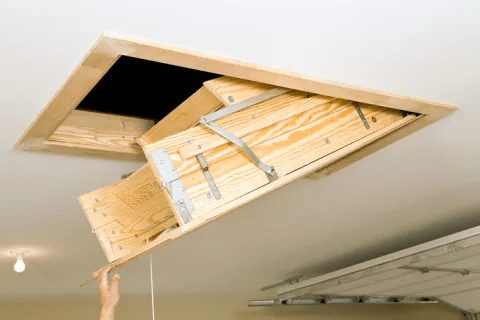
However, leaving the attic door open can create more problems than it solves. In this guide, we’ll break down when it might help, when it can cause damage, and what experts recommend instead.
Read too: No Power to Genie Garage Door Opener – Resolving the Issue with Ease: Troubleshooting Guide
Should You Leave Your Attic Door Open In Garage? Here’s the Truth
The short answer: No, in most cases you should not leave your attic door open in the garage.
While it may appear to improve ventilation, it often:
- Increases heat transfer
- Disrupts insulation performance
- Creates moisture problems
- Reduces energy efficiency
To understand why, let’s look at how attic ventilation works.
According to basic ventilation principles outlined in Wikipedia – Attic, attics are designed with controlled airflow using soffit and ridge vents—not through interior openings.
Attics are meant to be separated from living spaces and garages by insulated barriers.
Why Do People Leave Their Garage Attic Door Open?
Common reasons include:
✔ Trying to release trapped garage heat
✔ Attempting to cool attic
✔ Improving airflow
✔ Reducing humidity
The idea sounds practical. But building science says otherwise.
Does Opening the Attic Door Cool the Garage?
Usually not.
Hot air naturally rises. However, opening the attic door often allows:
- Hot attic air to enter garage
- Garage fumes to enter attic
- Heat exchange between spaces
If your attic is hotter than your garage (which it often is), opening the door can increase garage temperature.
Attic temperatures can reach 130–150°F during summer in many U.S. regions.
What Happens When You Leave the Attic Door Open?
1. Energy Efficiency Loss
Garage ceilings are typically insulated to separate conditioned and unconditioned spaces.
Opening the attic access:
- Breaks the thermal barrier
- Reduces insulation effectiveness
- Allows heat transfer into adjacent rooms
If your garage shares walls with your home, this increases HVAC load.
Energy experts estimate poor attic sealing can increase cooling costs by 5–20%.
2. Moisture and Condensation Problems
In humid climates, leaving the attic door open can:
- Allow moist air into attic
- Cause condensation on roof sheathing
- Promote mold growth
Moisture trapped in attics is a leading cause of structural damage.
3. Fire Safety Concerns
Garages are considered higher fire-risk zones.
Opening the attic access compromises:
- Fire separation
- Smoke containment
- Code compliance
Garage ceilings are often designed as fire barriers.
Leaving the attic door open defeats that purpose.
When Might It Be Acceptable?
There are rare situations where temporary opening may help.
✔ During short-term inspection
✔ While installing ventilation fan
✔ During attic work
But this should never be permanent.
Better Ways to Cool a Hot Garage
If your goal is temperature control, here are smarter alternatives.
Step 1: Improve Garage Insulation
Add insulation to:
- Garage door
- Ceiling
- Shared walls
Proper insulation reduces temperature swings by 10–20°F.
Step 2: Install Proper Attic Ventilation
Attics should use:
- Soffit vents
- Ridge vents
- Gable vents
- Powered attic fans
Ventilation must move air from outside—not from garage.
Step 3: Add Garage Ventilation
Instead of opening attic door:
- Install wall exhaust fan
- Add roof vent fan
- Use solar-powered ventilation
These methods control airflow safely.
Step 4: Seal Attic Access Door
If you feel air leakage:
- Install weather stripping.
- Add foam board insulation to attic hatch.
- Use attic tent cover.
Sealing access improves efficiency significantly.
Does Opening the Attic Door Help in Winter?
In winter, opening attic access is also problematic.
Warm garage air rising into attic can:
- Cause condensation
- Lead to ice dams
- Increase heating costs
Attics must remain isolated from interior air.
Pros vs Cons of Leaving Attic Door Open
Pros
✔ Temporary access convenience
✔ Short-term air movement
Cons
✘ Higher energy bills
✘ Moisture damage risk
✘ Reduced insulation efficiency
✘ Fire safety risk
✘ Poor indoor air quality
The risks outweigh benefits.
What Do Building Codes Recommend?
Most building codes require:
- Fire-rated separation between garage and attic
- Insulated ceiling barrier
- Sealed access panels
Leaving attic door open may violate local codes.
Real-World Scenario Example
Garage temp: 100°F
Attic temp: 140°F
Opening attic access creates upward heat flow but also pulls superheated attic air into garage.
Result: Garage may become even hotter.
Controlled ventilation works better.
Signs Your Attic Access Is Causing Problems
Look for:
- Drafts near ceiling
- High utility bills
- Musty smell
- Visible condensation
- Insulation sagging
These are signs of poor attic sealing.
FAQ: Should You Leave Your Attic Door Open In Garage
1. Will opening attic door cool my garage?
Usually no. It may increase heat if attic is hotter.
2. Is it dangerous to leave attic door open?
It can increase fire risk and moisture damage.
3. Does attic door affect home energy bills?
Yes. Poor sealing increases HVAC workload.
4. Should attic door be insulated?
Yes. Insulated and sealed access improves efficiency.
5. Can attic ventilation fix garage heat?
Yes, if properly designed using exterior vents.
6. Is it okay temporarily?
Yes, briefly for inspection or repairs—but not long term.
Conclusion
So, Should You Leave Your Attic Door Open In Garage? In most cases, the answer is no.
Opening the attic access compromises insulation, increases heat transfer, raises energy costs, and can create moisture and safety risks. Instead of opening the attic door, focus on proper insulation and ventilation solutions designed for garages and attics separately.
If this guide helped you understand the risks and smarter alternatives, share it on social media to help other homeowners protect their homes and save on energy costs.
Leave a Reply